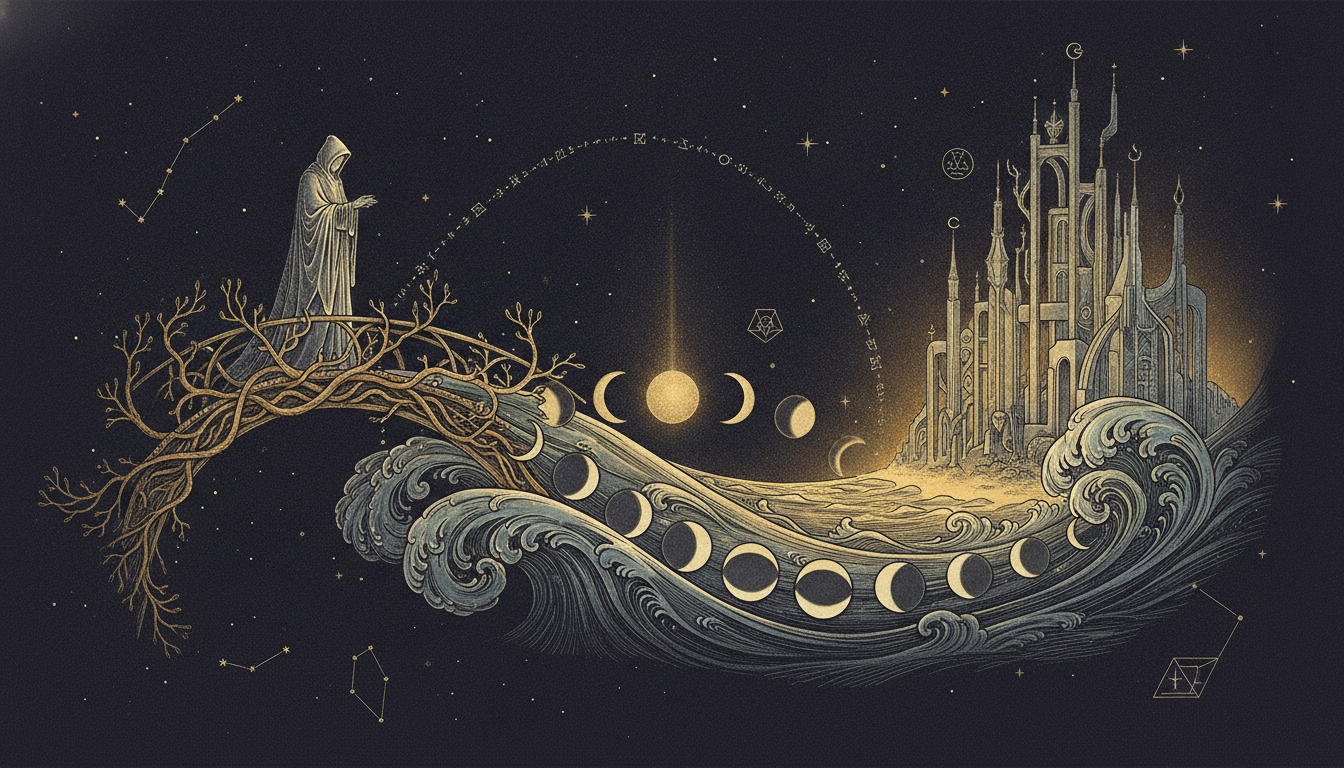
You've felt the trap. Something lands in front of you, a job, a trip, a person, and your whole body lights up with yes. You commit on the spot. Then you wake up two days later staring at the ceiling wondering what you were thinking. If that pattern runs through your life, there's a decent chance you carry emotional authority, and nobody ever told you the one rule that changes everything: for you, there is no clarity in the moment.
Roughly half of all people have this authority. It's the most common one in the system, and it's also the one most punished by a culture that treats fast decisions as strong ones.
What is emotional authority, mechanically?
In Human Design, your authority is the center in your chart that's built to make decisions. Emotional authority means your Solar Plexus center is defined, and here's the key rule: whenever the Solar Plexus is defined, it takes the wheel. Defined Sacral, defined Spleen, doesn't matter. The emotional system outranks them all.
Your chart calculator reads this straight from your birth data. One caution: authority is sensitive to your exact birth time, and a time that's off by an hour can hand you the wrong one. If yours is uncertain, the free birth time finder shows whether your authority is even in question and helps you narrow it down.
The wave: why "right now" lies to you
A defined Solar Plexus moves in a wave. Your emotional state rises toward hope and excitement, falls toward flatness or pain, and passes through calm in between, on its own schedule, with or without a reason. That's the machinery working, and it never turns off.
Here's what that does to decisions. When the wave is high, everything looks like a yes. When it's low, everything looks like a no. The choice didn't change. Your altitude did. So a decision made at either extreme is really a decision made by the weather.
Sit with how much of your history that explains. The purchase made in euphoria. The resignation drafted in despair. The relationship question that had four different answers in four days. None of that was brokenness. It was an emotional being making instant decisions with a system that was never built for them.
Waiting for clarity: how it actually works
The practice is simple to say: feel the decision from more than one place on your wave before you act.
Meet the choice when you're excited, and notice the answer. Meet it again when you're flat, and notice the answer. Meet it once more when you're calm. What you're looking for is the answer that survives the whole ride. Emotional clarity has a specific texture: cool, quiet, and a little boring compared to the spike of the high. It's a yes that doesn't need to be shouted, or a no that doesn't need to be justified.
Practically, this sounds like a handful of phrases worth wiring into your mouth: "Let me sleep on it." "I'll tell you tomorrow." "I want to feel this one out for a few days." Anyone who won't give you a night on a real decision is telling you something about the deal.
Scale the wait to the weight. Choosing lunch doesn't need a lunar retreat. Choosing a business partner deserves the full tour of your wave.
The relief in this
If you've spent your life being told you're indecisive, moody, or too emotional, look again at what your design actually says: you carry deep emotional intelligence, and your decisions ripen. Depth takes time. The people around you get the benefit too, because a settled answer from you is one of the most reliable answers there is. The wave that made you doubt yourself is the same equipment that lets you feel a situation all the way to the bottom, long before the spreadsheet catches up.
Where to go next
Authority is one layer of the chart. Your type and strategy describe how your energy engages the world, your profile describes the role you play, and reading them in the right order is the difference between insight and noise. Start with How to Read Your Human Design Chart if you're new.
And if you want to hear how your emotional authority weaves through your whole design, your type, your profile, your specific channels, a personalized YouCast episode walks through it out loud, as a real conversation about you, built from your exact chart.