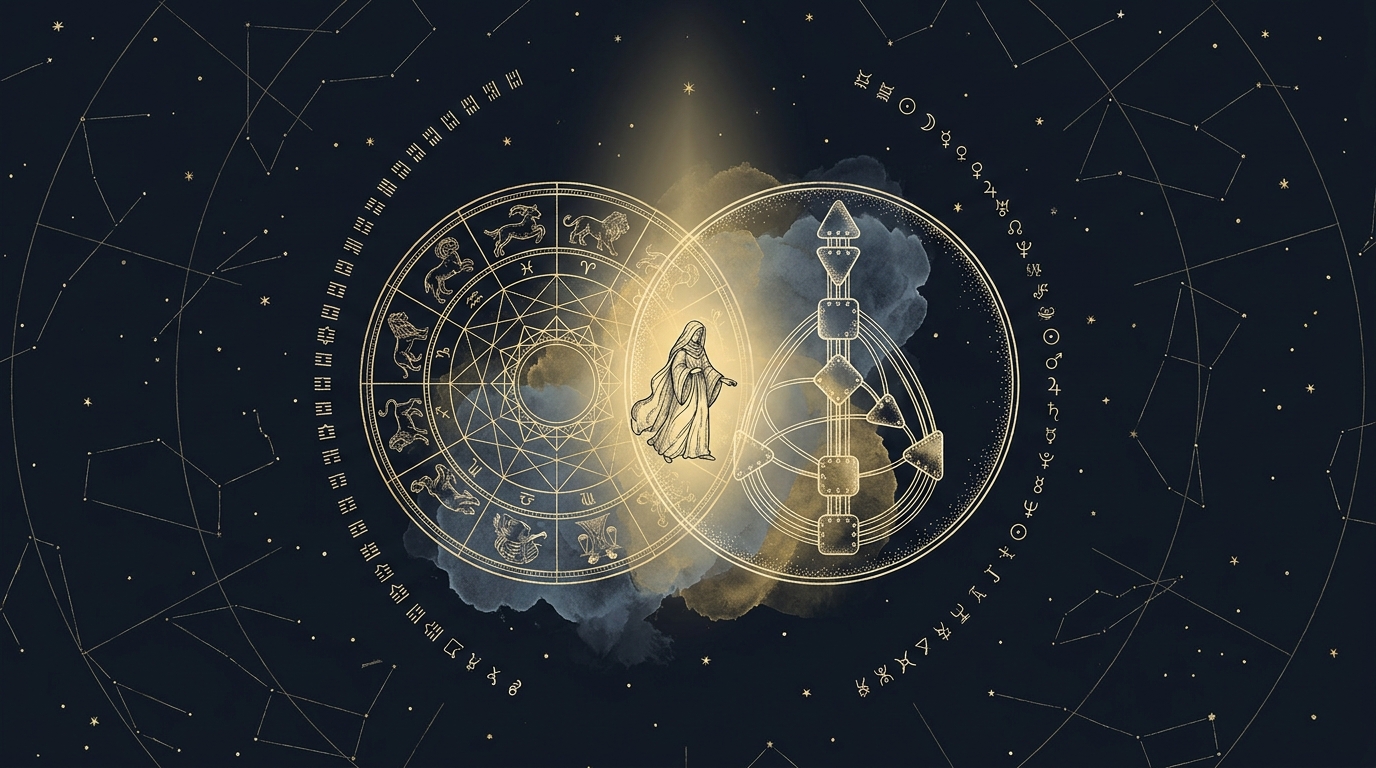
People assume Human Design is a flavor of astrology, and you can see why. Both ask for your exact birth time. Both produce a chart full of planets and symbols. Both get filed under the same shelf at the bookstore. But the moment you actually use them, the difference is obvious. They're reading the same sky to answer completely different questions.
Astrology asks what the planets mean for your personality, your timing, and your life themes. Human Design asks how your specific energy is built and how you're meant to make decisions with it.
Do they use the same birth information?
Yes, exactly the same three things: your birth date, your exact birth time, and your birth location. Both systems are time-sensitive, and in both, a wrong birth time hands you a clean-looking chart that describes someone who isn't you. If you don't know your exact time, the free birth time finder works for both systems: it shows which parts of your chart are already certain and helps you narrow down the rest.
This shared starting point is why the confusion exists. The raw astronomy, where the Sun, Moon, and planets sat at the moment you were born, is calculated the same way for both. What happens next is where they split.
What does astrology actually do?
Astrology reads the meaning of those planetary positions. Your Sun sign points to your core identity, your Moon sign to your emotional inner world, your rising sign to how you meet the world, and the houses and aspects layer in life areas and the relationships between planets.
It's especially strong on two things. First, personality: a detailed language for who you are and how you're wired emotionally. Second, timing: transits and progressions track how the current sky interacts with your birth chart, which is why astrologers talk about a hard Saturn season or a Jupiter year. Astrology gives you a rich symbolic vocabulary for the texture of a life and the seasons it moves through.
What does Human Design actually do?
Human Design takes the same planetary positions and runs them through a different machine. It maps each position onto one of 64 gates (drawn from the I Ching), arranges those gates across nine energy centers (drawn from the chakra system), and produces a mechanical readout of how your energy works.
The output is a decision-making manual for your specific body. The core pieces are your type, your strategy, and your authority:
| Layer | The question it answers |
|---|---|
| Type | What kind of energy you carry and how it's built to engage |
| Strategy | The one rule for how to engage the world correctly |
| Authority | How decisions are actually meant to be made for you, in your body |
That last one is the heart of it. Where astrology might describe your emotional nature, Human Design tells you, mechanically, "don't make a decision in the heat of a feeling, wait for the wave to settle." It wants to change how you handle an ordinary Tuesday. If you want the full walkthrough, start with How to Read Your Human Design Chart.
Is Human Design a branch of astrology?
Not really. Astrology went in as one ingredient among several. Human Design is a synthesis of four older systems plus modern science:
- Astrology provides the planetary positions and the 88-degree solar arc for the Design side of the chart.
- The I Ching provides the 64 gates, mapped onto the 64 hexagrams.
- The Hindu-Brahmin chakra system provides the nine centers.
- The Kabbalah (the Tree of Life) informs the channel structure.
- Biochemistry and genetics are where the 64-gate / 64-codon parallel comes from.
So calling Human Design "astrology with extra steps" misses what it is. It borrowed astrology's clock and built a different instrument around it.
Which one should you use?
This isn't an either-or. They answer different questions, so the real test is which question you care about.
Reach for astrology when you want to understand timing, seasons, and the symbolic texture of your personality and relationships. Reach for Human Design when you want a practical tool for decisions and energy management, something you can apply this week. Plenty of people run both, using astrology for the why and the when, and Human Design for the how.
On accuracy, be honest with yourself. Neither system is scientifically proven, and chasing "is it real" usually leads nowhere useful. The better question is whether the framework gives you something true and usable about your own life when you test it.
The part a page can't give you
Whichever lens you pick, reading about it has the same ceiling. A static chart or a generic report lists your placements, but it can't sit with you and talk through how your specific pieces actually fit together, in your words, for your life.
That's the gap YouCast was built to close, on the Human Design side. You enter your birth data once, and you get back a personalized podcast episode that walks through your whole chart as a real conversation about you, your type, your authority, your profile, and the channels that make you you. The same data you'd read about here, produced as audio you can sit with and return to, instead of a report you skim once and lose in a downloads folder.