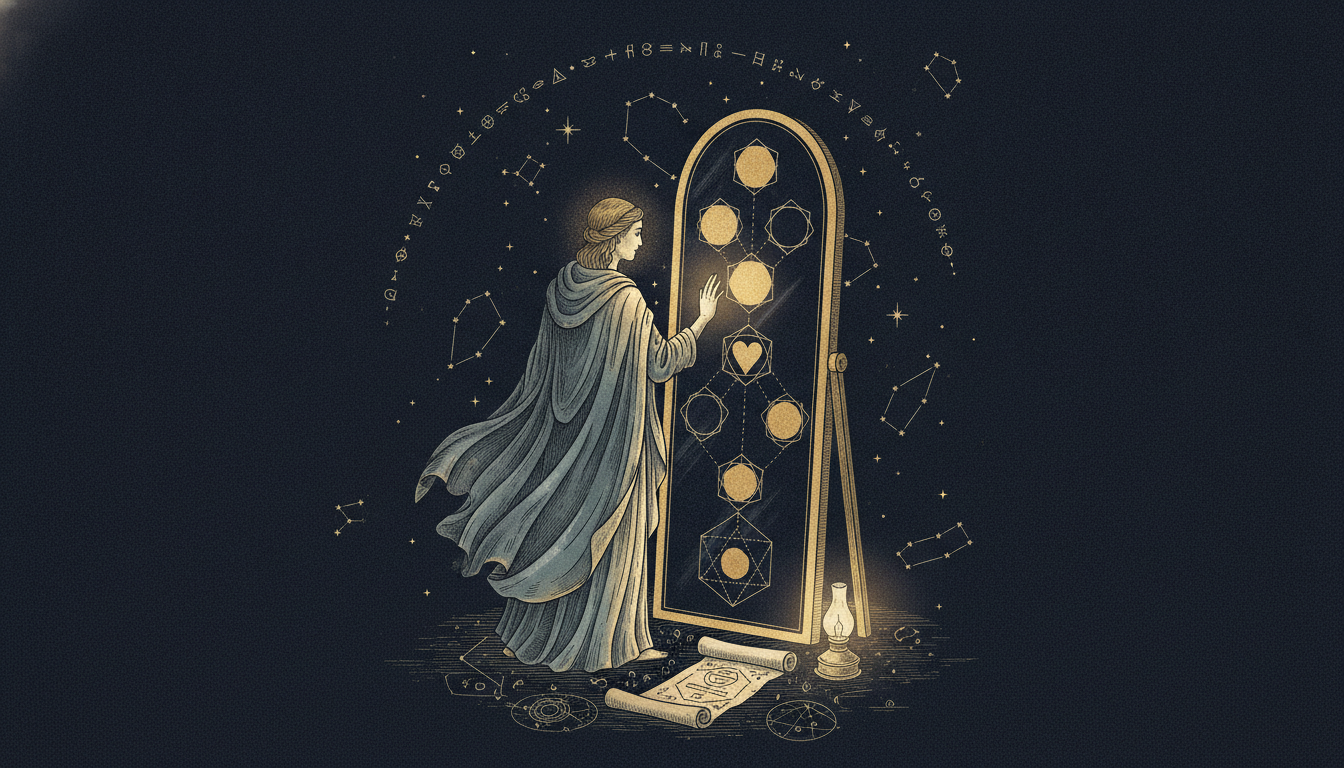
Your Human Design chart is a map of how your energy works. It shows how you're built to engage with life, how you make decisions you won't regret, where you're steady, and where you soak up the people around you.
So why does it look like a subway map drawn by a geometry teacher? Because every shape, line, and number is answering a different question about you. Once you know which question each part answers, the chart gets a lot friendlier.
What does a Human Design chart actually tell you?
A Human Design chart tells you how you operate. It's calculated from your birth date, time, and place, and it describes mechanics: how your energy runs, how you decide well, and how you tend to affect other people. It makes no predictions about what will happen to you.
Each part of the chart answers one question:
| Part of the chart | The question it answers |
|---|---|
| Type | How does my energy engage with the world? |
| Strategy | How do I get into the right things with the least resistance? |
| Authority | How do I make a decision I can trust? |
| Profile | What role do I play, and how do I learn? |
| Centers (the nine shapes) | Where am I consistent, and where am I influenced? |
| Channels and gates | What specific traits and gifts do I carry? |
| Red and black numbers | Which traits do I see in myself, and which do others see first? |
If you'd like the step-by-step order for working through all of it, how to read your Human Design chart covers that. This page is about what each piece means.
What does my Human Design type mean?
Your type describes the basic way your energy works and how other people feel it. There are five, and each one comes with a strategy, a feeling that shows up when you're off track, and a feeling that shows up when you're on it.
| Type | Share of people | Strategy | Off track | On track |
|---|---|---|---|---|
| Generator | About 37% | Wait to respond | Frustration | Satisfaction |
| Manifesting Generator | About 33% | Wait to respond, then inform | Frustration and anger | Satisfaction |
| Projector | About 20% | Wait for the invitation | Bitterness | Success |
| Manifestor | About 9% | Inform before acting | Anger | Peace |
| Reflector | About 1% | Wait a lunar cycle | Disappointment | Surprise |
The two right-hand columns are the useful part. A Generator who feels frustrated most days is usually saying yes to things their gut never agreed to. A Projector who feels bitter is usually giving guidance nobody asked for. The feeling works like a dashboard light. It tells you something about how you got into the situation you're in.
The five Human Design types goes deeper on each one.
What does my authority mean?
Your authority is your reliable way of making decisions. It comes from which centers are defined in your chart, and it follows a fixed order.
If your Solar Plexus is defined, you have emotional authority, and you decide well by waiting out your emotional wave instead of answering in the moment. That's about half of all people. If the Solar Plexus is open and the Sacral is defined, you have sacral authority, a gut yes or no in the present moment. After those come splenic, ego, self-projected, mental (also called environmental), and lunar authority for Reflectors.
Here's why authority matters so much: the mind is excellent at research, comparison, and making a case. Human Design says it's a poor place to make the final call from. Your authority names the place in your body where the call gets made.
Strategy and authority together are the parts you can test this week. Everything else on the chart is detail on top of them.
What does my profile mean?
Your profile is the pair of numbers, like 1/3 or 4/6, and it describes the role you play in life and how you learn. There are 12 profiles, built from six lines.
The first number is conscious. It's the part of your character you recognize. The second number is unconscious. It shows up in how your life actually unfolds, and other people often see it more clearly than you do.
A 1/3, for example, studies until the ground feels solid and then learns everything else by trying things and finding out what breaks. A 2/4 has natural talents they barely notice, and needs both time alone and a close circle that calls those talents out. Same type, very different lives.
What do the colored and white shapes mean?
The nine shapes are centers, and each one handles a theme: communication, identity, willpower, emotion, life force, and so on. Whether a center is colored in tells you how that theme works in you.
A colored center is defined. It runs the same way every day, no matter who's in the room. That's the dependable part of you, the part others feel from you.
A white center is open or undefined. You take in that energy from the people around you and amplify it, so it changes with your company. White centers are where most of your conditioning lives. They're also where you can become wise, because you get to experience that theme in every flavor instead of just one.
A lot of people get their first real "oh" from a white center. If your Solar Plexus is white, plenty of the emotion you've been calling yours started in someone else. If your Sacral is white, you've likely been running on borrowed stamina and wondering why you crash. Defined vs undefined centers walks through all nine.
What do the numbers and lines on my chart mean?
The numbers are gates, and the lines are channels. There are 64 gates and 36 channels in the system.
A gate is a specific trait. A channel is two gates meeting, one at each end, and a complete channel is what colors in the two centers it connects. So your channels are the reason your defined centers are defined. They're also your most consistent gifts, the things you do reliably without trying.
A gate on its own, with no partner at the other end, is called a hanging gate. It's still yours. It just tends to come alive around people who carry the gate that completes it, which explains a lot about who you feel drawn to.
What do the red and black numbers mean?
Black is your Personality side, calculated from where the planets were at the moment you were born. These are the traits you know you have. If someone described them to you, you'd nod.
Red is your Design side, calculated from about 88 days before birth. These traits run in the body, below your awareness. Friends and family usually spot them before you do, which is why a description of your red gates can feel oddly exposing.
Some gates and channels show both colors, striped. You have those traits consciously and unconsciously at once.
Why does the same piece mean something different in my chart?
Because no part of a chart acts alone. A defined Sacral means one thing in a person with an open Solar Plexus, where the gut answers right now and can be trusted right now. It means something else in a person with a defined Solar Plexus, where that same gut answer has to hold up across a few days of feeling.
Profiles work the same way. A 5/1 Projector and a 5/1 Manifestor share a role and almost nothing about how they get into it. One waits to be recognized and invited. The other starts things and tells people on the way.
This is the gap between knowing what the pieces mean and knowing what your chart means. Definitions are the vocabulary. Your chart is a sentence, and the meaning sits in how the words combine. That combining is what a personalized reading does.
How do I know my chart is accurate?
Your chart is only as accurate as your birth time. The Moon changes gates about every ten hours, and profile lines shift faster than that, so a time that's off by an hour can change your profile, a center, or your whole type.
A birth certificate is the best source. If you don't have an exact time, the free birth time finder scans your chart across the whole day and shows you which parts hold steady and which parts depend on the hour.
There's a simpler test too. Read the description of your type's off-track feeling. If it describes a pattern you've lived with for years, you're probably looking at the right chart.
Where to go next
Start with the two parts you can try out immediately. Find your type in the five types, then read the article for your authority and run it on one real decision.
And if you'd rather hear what all of it means together, for you specifically, a personalized YouCast episode talks through your whole chart from your exact birth data.