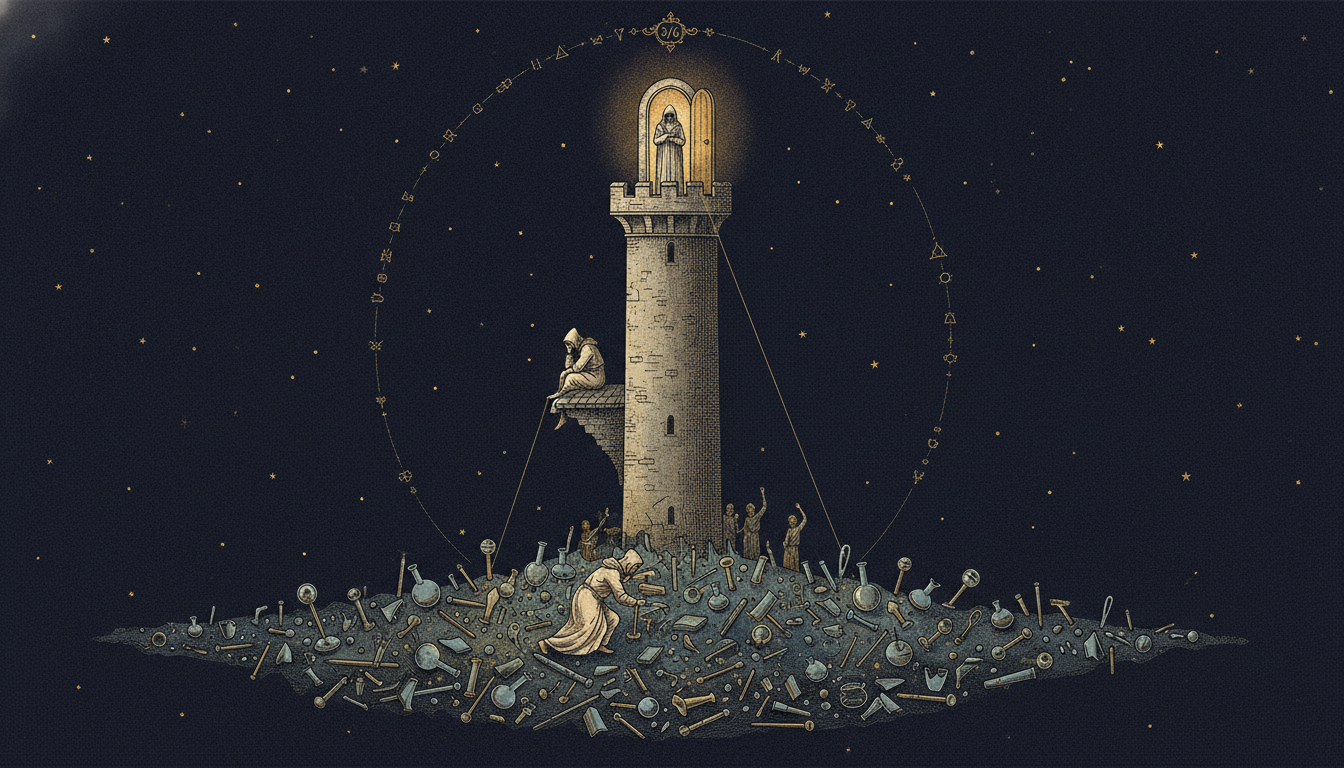
If your Human Design profile is 3/6, you're a Martyr-Role Model, and the two halves of that name describe a life that changes shape as it goes. The first stretch is messy on purpose. The middle stretch is quiet and strangely removed. The last one is where all the wreckage from the first turns into something other people can actually use.
Your profile comes from the lines of your conscious and unconscious Sun placements, and it sits on top of your type and authority as the role you're here to play.
What do the two numbers in a profile mean?
Every profile is two numbers from one to six. The first is conscious, the side you recognize and could describe out loud. The second is unconscious, the side that runs in the background and that other people usually notice about you before you do.
The six lines are 1 Investigator, 2 Hermit, 3 Martyr, 4 Opportunist, 5 Heretic, 6 Role Model. A 3/6 carries the 3 in front and the 6 underneath.
The lines come from the 64 gates, each of which is divided into six equal parts. The Sun moves through one of those parts in roughly 22 hours, so your profile is fairly stable across a fuzzy birth time unless you were born close to a line boundary.
What is the 3rd line, the Martyr?
The 3rd line learns by trial and error. It finds out what's true by trying it, watching a good portion of it fall apart, and keeping whatever survived contact with reality.
The traditional name points at how this looks from outside: a lot of visible failure, bonds formed and then broken, jobs started and left, plans that collapse in public. A 3rd line is the person whose life story has more chapters than everyone else's by age 25.
The reframe that matters here is about the direction of the learning. A 3rd line is built to discover, and discovery requires the experiment to be allowed to fail. Every collapsed plan hands over a piece of information that no amount of reading could have produced. The wisdom a 3rd line ends up with is unusually reliable, because it was earned by contact rather than by theory.
The cost is real, though, and pretending otherwise does 3rd lines no favors. Society calls this pattern flaky. A 3/6 who absorbs that judgment spends decades treating their own method as evidence of a defect.
What is the 6th line, the Role Model?
The 6th line is the only line in the system that lives its life in three distinct phases, and each one operates by different rules.
That three-part structure is why 3/6 people so often report that their life feels like it belongs to several different people. The 6th line doesn't develop steadily. It switches modes at two fairly specific points, both of them tied to slow planetary cycles that everyone shares.
What are the three life phases of a 3/6?
| Phase | Roughly | What runs the show |
|---|---|---|
| One | Birth to age 29-30 | Trial and error, the 6th line behaving like a 3rd line |
| Two | Age 30 to age 50 | On the roof: observing, healing, staying out of the fray |
| Three | Age 50 onward | Off the roof, living as an example of what was learned |
The first turn comes at the Saturn return, when Saturn completes its orbit and arrives back where it sat when you were born, at around 29 and a half years old. The second comes at the Chiron return, roughly age 50, since Chiron takes about fifty years to circle the Sun. Both are ordinary astronomy, and both are used across Human Design as the markers for the 6th line's transitions.
Phase one is the loud one. Everything gets tested, most of it doesn't hold, and the person is often exhausted and privately convinced that other people got handed some instruction manual they were never handed.
Phase two is the strange one. Somewhere around 30 the 6th line goes up on the roof, and life gets noticeably more removed. There's less appetite for the fight, more distance from other people's drama, and a lot of watching. Plenty of 3/6s find this period lonely and read it as stalling out. What's happening is that the material gathered in phase one is being sorted, and a great deal of quiet repair is going on underneath.
Phase three is where the design pays out. The 6th line comes down off the roof and starts living what it figured out. In practice that looks fairly ordinary: people watch how you handle something difficult and take instruction from it, without either of you making a speech about it. Being a role model in this sense asks for no title, no credential, and no stage.
Why is the first phase so heavy for a 3/6 specifically?
Because both lines are experimenting at the same time.
The conscious 3rd line is out testing everything by nature. And the 6th line, during its own first phase, behaves exactly like a 3rd line too. So a 3/6 under 30 is running double trial and error with nothing in the chart pulling toward caution. That combination produces the profile's reputation: dramatic first three decades, an unusual number of endings, and a suspicion that they're doing life wrong.
They aren't. The volume of experience gathered in those years is the raw material the whole rest of the design depends on. A 3/6 who arrives at 50 with nothing tried has nothing to be a role model of.
The practical instruction for a young 3/6 is narrow and useful: stop grading the experiments. Notice what you learned, notice whether you want to keep it, and go again. The judgment that a failed attempt says something about your character is the single heaviest thing a 3/6 carries, and it's imported from outside the chart.
What is a 3/6 like in relationships?
Bond-making and bond-breaking is central to the 3rd line, and it shows up in friendships and partnerships as much as in work.
Phase one tends to include several relationships that end, sometimes abruptly, each one teaching something specific about what does and doesn't work for this person. Phase two often brings a quieter and more selective social life, with a smaller circle and less patience for maintenance. Phase three tends to bring depth, since the 6th line by then knows precisely what it's looking for and has stopped auditioning.
None of that is a forecast, and a chart never dictates who you end up with. It describes a tendency in how a 3/6 tends to move through people, which is helpful mostly because it takes the sting out of the early pattern.
How do I find out my profile?
Your profile is calculated from your birth date, exact birth time, and birth location, the same way your type and authority are.
Profile is more forgiving of a fuzzy birth time than most of your chart, since the Sun holds a line for about 22 hours rather than the ten hours the Moon spends in a gate. The risk is being born near a boundary, where an hour or two flips a 3/6 into a 3/5 or a 4/6 and changes the reading substantially. If your time came off a family story rather than a birth certificate, the free birth time finder shows you which parts of your chart hold steady and which ones hinge on the hour.
Where to go next
Your profile is one layer, and it plays out differently depending on your energy type and the way you're built to make decisions. A 3/6 Generator and a 3/6 Projector live very different versions of the same three phases.
If you share the 3rd line, the 3/5 profile shows what happens when it pairs with the 5th line instead. If the phases are the part that landed, the 4/6 and the 6/2 are the other two profiles carrying the same three-part arc. And how to read your chart puts the profile back in order with everything else.
If you want your 3/6 walked through as it actually runs in your life, with your type, your authority, and the specific channels in your chart threaded into it, that's what a personalized YouCast episode is. Your whole design talked through out loud, built from your exact birth data.