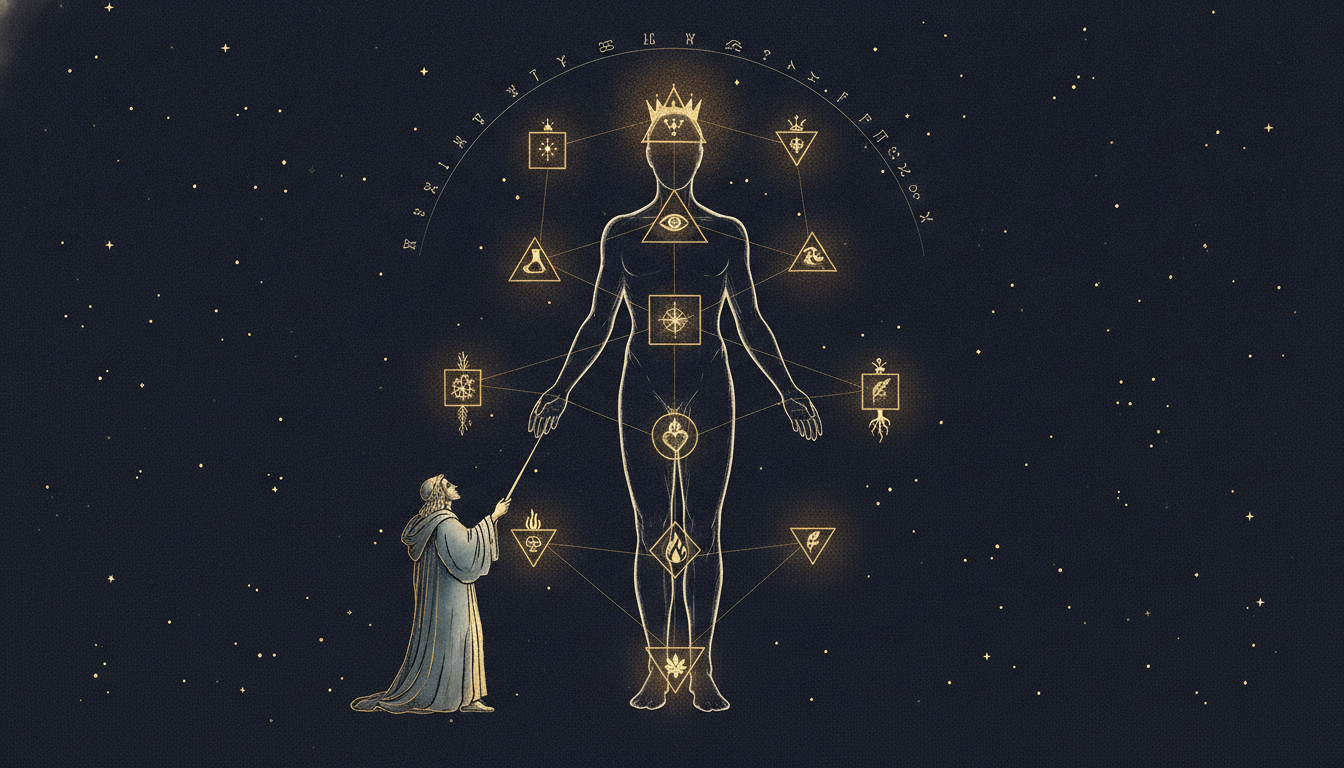
The nine centers are the geometric shapes running down your Human Design chart, from the triangle at the top of the head to the square at the base of the spine. Each center handles one kind of energy. Some drive action, some carry awareness, and some put pressure on you to think or move. The pattern of which ones are colored in is the backbone of your whole chart.
If you've looked at your bodygraph and wondered why some shapes are filled and some are white, this is the page that explains it.
What are the nine centers in Human Design?
The nine centers are the Head, Ajna, Throat, G, Heart, Solar Plexus, Sacral, Spleen, and Root. Together they hold all 64 gates, the same 64 hexagrams found in the I Ching.
| Center | What it handles | Role | Gates |
|---|---|---|---|
| Head | Inspiration, questions, mental pressure | Pressure | 3 |
| Ajna | Thinking, concepts, opinions | Awareness | 6 |
| Throat | Speech and action | Manifestation | 11 |
| G | Identity, direction, love | Identity | 8 |
| Heart (Ego/Will) | Willpower, self-worth, promises | Motor | 4 |
| Solar Plexus | Emotions and feeling waves | Motor and awareness | 7 |
| Sacral | Life force, work energy, sexuality | Motor | 9 |
| Spleen | Intuition, instinct, immune health | Awareness | 7 |
| Root | Adrenaline, drive, stress | Motor and pressure | 9 |
The Throat holds the most gates because nearly everything in the chart is trying to reach it. That's where energy turns into words or action you can see.
What's the difference between motor, awareness, and pressure centers?
The centers sort into three working groups, plus the Throat and G, which play their own parts.
Motors supply fuel. There are four: the Sacral, the Solar Plexus, the Heart, and the Root. When a motor connects to the Throat, a person can act on their own steam, and that one connection separates Manifestors and Manifesting Generators from everyone else.
Awareness centers are the three ways a human can know something. The Spleen knows in the moment, as a hit of instinct. Thinking it over is how the Ajna knows. The Solar Plexus knows over time, as a feeling that settles.
Pressure centers push. The Head pushes you to find answers, and the Root pushes you to get things moving. The Root counts as both a motor and a pressure center, and the Solar Plexus counts as both a motor and an awareness center.
The G center sits in the middle of the chart and carries your sense of self and the direction your life takes. It holds no fuel and no awareness. It's the part of you that knows where you're going when you're in the right place with the right people.
What does it mean when a center is defined or open?
A defined center is colored in. It's connected to another center by a complete channel, so its energy runs the same way all the time. That's the part of your nature you can rely on, and it's also what other people pick up from you.
An open or undefined center is white. It has no fixed way of working, so it takes in the energy of whoever is nearby and often amplifies it. Someone with an open Solar Plexus can walk into a tense room and feel the tension more strongly than the people who brought it.
Neither is better. Open centers are where conditioning happens, and they're also where you learn the most about other people. The full breakdown is in defined vs undefined centers.
Why does Human Design have nine centers when there are seven chakras?
The layout echoes the chakra system, which is one of the traditions Human Design draws from, but the chart has nine centers. Human Design's own claim is that people shifted from seven-centered to nine-centered beings around 1781. That claim sits outside anything science has tested, and is Human Design real? covers what can and can't be checked. The practical point is simpler: nine centers give more places to look, which is why the chart can tell willpower apart from identity and instinct apart from emotion.
How do your centers decide your type?
Your type comes straight from which centers are defined and how they connect.
- Generator (about 37%): the Sacral is defined, and no motor connects to the Throat.
- Manifesting Generator (about 33%): the Sacral is defined, and a motor connects to the Throat.
- Manifestor (about 9%): the Sacral is open, and a motor connects to the Throat.
- Projector (about 20%): the Sacral is open, no motor reaches the Throat, and at least one center is defined.
- Reflector (about 1%): all nine centers are open.
That's why the Sacral gets so much attention. It's the single center that splits the population roughly 70/30. The five types go deeper on how each one moves.
How do your centers decide your authority?
Your authority is the center you're meant to make decisions from, and it follows a fixed order. The highest defined center on this list wins:
- Solar Plexus defined: emotional authority. This overrides everything below it.
- Sacral defined: sacral authority.
- Spleen defined: splenic authority.
- Heart connected to the Throat or G: ego authority.
- G connected to the Throat: self-projected authority.
- Only the Head, Ajna, and Throat defined: mental or environmental authority.
- No centers defined: lunar authority, for Reflectors.
A Generator with a defined Solar Plexus uses emotional authority, even with a working Sacral, because the emotional wave has to settle before the gut response can be trusted.
What does each open center tend to feel like?
Each open center comes with a classic trap, and Human Design phrases it as a question you can ask yourself:
| Open center | The question to ask |
|---|---|
| Head | Am I thinking about things that don't matter to me? |
| Ajna | Am I trying to convince everyone I'm certain? |
| Throat | Am I trying to get attention? |
| G | Am I still looking for love and direction? |
| Heart | Am I still trying to prove myself? |
| Solar Plexus | Am I avoiding confrontation and truth? |
| Sacral | Do I know when enough is enough? |
| Spleen | Am I holding on to what isn't good for me? |
| Root | Am I rushing so I can be free of the pressure? |
If a question lands a little too well, that center is probably open in your chart, and you've spent years treating someone else's energy as yours.
Why does your birth time matter for your centers?
A center becomes defined only when a channel is complete, and one gate is enough to complete or break a channel. The Moon moves into a new gate roughly every ten hours, so a birth time that's off by a few hours can color in a center or leave it white, and that can change your type and your authority along with it. If your birth time is a guess, the free birth time finder helps you narrow it down.
Where to go next
The centers are the map, and your type, authority, and profile are what the map adds up to. Start with defined vs undefined centers if you want the full picture of openness, or your authority page if you want to know how to decide.
If you'd rather hear your own nine centers talked through as they actually run in your life, that's what a personalized YouCast episode does, built from your exact birth data.