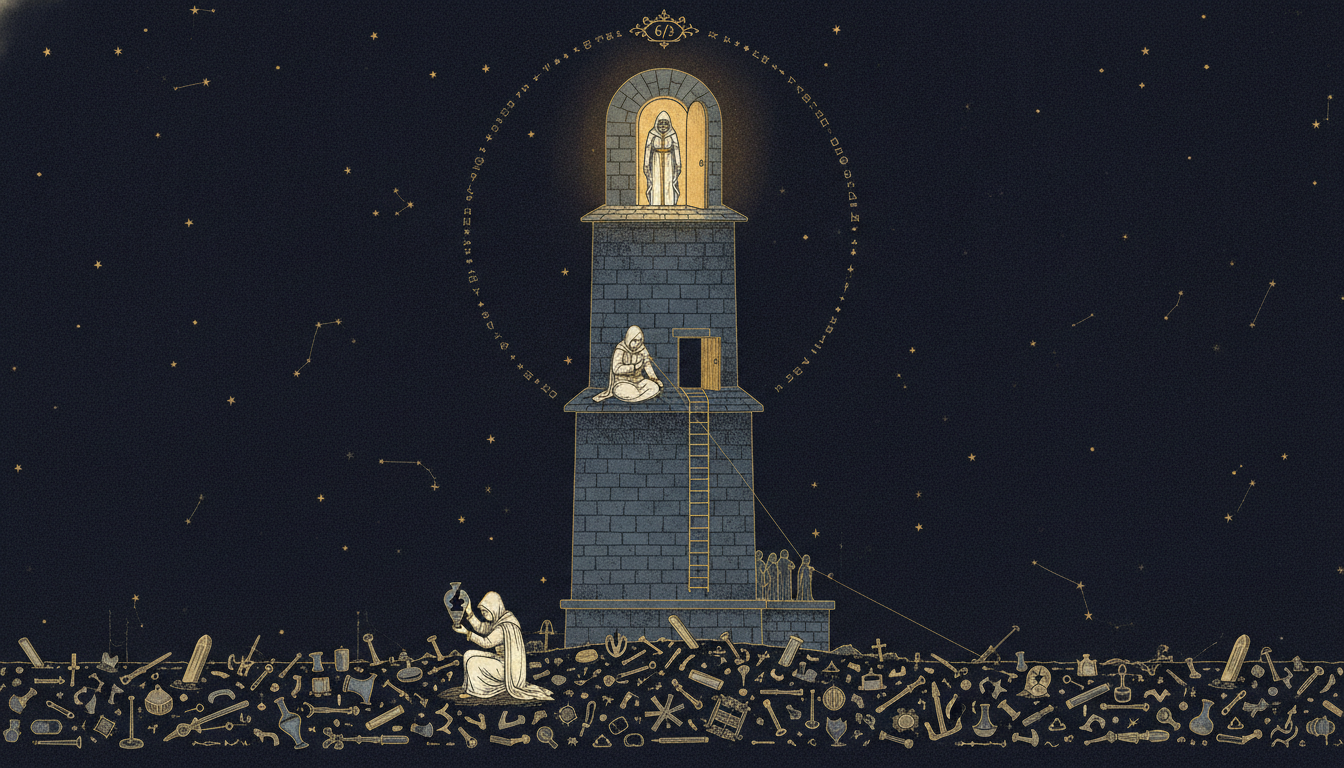
If your Human Design profile is 6/3, you're a Role Model-Martyr, and your life has probably involved more false starts than anyone around you. That is the design working, and the 6/3 is the one profile where the first thirty years are built almost entirely out of experiments. The 6th line spends its youth running like a 3rd line, and the 3rd line underneath is doing the same thing, so you got a double dose of trial and error before the rest of the story could begin.
Your profile comes from the lines on your conscious and unconscious Sun and Earth placements, and it sits on top of your type and authority as the role you play while your strategy does its work.
What do the two numbers mean?
Every profile is two numbers from one to six. Each number is a "line" with its own character, and the six are: 1 Investigator, 2 Hermit, 3 Martyr, 4 Opportunist, 5 Heretic, 6 Role Model.
The first number is your conscious line, the part you can feel and describe about yourself. The second runs unconsciously, usually obvious to everyone but you. A 6/3 carries the 6 and the 3.
Of the twelve profiles, seven are Right Angle, one (4/1) is Juxtaposition, and four are Left Angle: 5/1, 5/2, 6/2, and 6/3. As a Left Angle profile, your life is transpersonal, meaning the people who cross your path largely determine where it goes. The 6/3 is also the last profile in the sequence, which is why it's often described as a transition profile. The old patterns get broken in a 6/3 life, and something new gets lived in their place.
What does the 6th line, the Role Model, mean?
The conscious 6th line lives on a timeline, and the timeline has three chapters that feel like three different people.
Stage one, birth to around 30. The 6th line runs like a 3rd line, learning by trial and error. You try things, plenty of them fall apart, bonds form and break, and the mess is the method. For a 6/3 this stage runs hotter than it does for any other 6th line, because the unconscious 3rd line is already a trial-and-error line. Two engines pointed the same way. Most 6/3s look back on their twenties as a demolition derby and wonder what was wrong with them. Nothing was.
Stage two, roughly 30 to 50. You go "on the roof." The appetite for throwing yourself at life pulls back and you become an observer, watching how people operate, taking stock, healing what stage one cost you. Because the 6 is conscious in a 6/3, you tend to know exactly what's happening. You can feel yourself standing a step back from your own life even when you can't explain why to anyone else.
Stage three, around 50 on. You come off the roof and live what you learned. Being an example is the output, and it happens whether or not you ever say a word about it. Your authority in this stage is earned, since you ran the experiment yourself and then spent twenty years watching it from above.
The ages aren't hard walls, and the transitions run through the Saturn return around 30 and the Chiron return around 50, but the shape holds. Reading your own history against those three chapters explains a great deal about why your twenties felt nothing like your forties.
What does the 3rd line, the Martyr, mean?
The 3rd line learns by doing it wrong first. It picks up the approach, the job, the person, the city, lives inside it long enough to find the flaw, and then moves on carrying the lesson. Human Design calls this line the Martyr because it pays for the knowledge with its own experience and then hands the lesson to everyone else for free.
In a 6/3 that line is unconscious, which means you don't always see yourself doing it. From the inside it can feel like bad luck or bad judgment. Other people watch you and see someone with an unusual tolerance for starting over. Both views are describing the same mechanism, and the second one is more accurate.
Material discovery is the 3rd line's gift. You find out what actually works by touching it, and the things you learn this way stay learned. A 3rd line also tends to have a bonds-made-and-broken pattern in relationships, and that pattern is part of the design rather than a flaw in you. The relationships that end taught something the ones that lasted couldn't.
How does a 6/3 actually work?
You run experiments, and the experiments are the point. A 6/3 that tries to skip the mistake phase and go straight to wisdom ends up with nothing to be wise about. The failed business, the wrong relationship, the move that didn't take, these are the raw material stage three is built from. Treating them as detours misses what they were.
The roof years work differently for a 6/3 than for a 6/2. The 6/2's unconscious 2nd line wants the door shut, so the roof can get very quiet. Your unconscious 3rd line keeps bumping into life even while the 6 is trying to observe, so your roof has a trapdoor in it. You'll find yourself pulled back into some situation to test it, then back up to the roof to make sense of it. That pattern can feel like you're failing at the roof. You're doing a 6/3 roof, which is a working one.
Resilience is the thing people notice about you. Where a lot of profiles get derailed by a setback, a 6/3 has usually been through enough of them that one more is just data. That toughness is real and it gets admired, and it also gets misread as not caring. Saying out loud that something hurt, even while you're already moving on, closes that gap.
What's the hardest part of being a 6/3?
Pessimism, mostly. A lifetime of finding out what doesn't work can harden into expecting things not to work, and a 6/3 who has stopped trusting the process stops running experiments and starts bracing instead. Human Design describes the 3rd line's healthy state as a kind of optimism about the process itself, where discovering what's wrong is understood as the fast road to what's right. Losing that is the real failure mode.
The second hard thing is self-judgment about the record. Looking back at a trail of ended things and reading it as a trail of failures. The record is the curriculum. A 6/3 at 55 who has lived their design is one of the wisest people in any room, and every piece of that wisdom came from something that didn't work out in their twenties.
Then there's impatience in stage one. Young 6/3s often feel like they should already be the steady, wise one, because the 6th line carries that image of itself from the start. Straining for it in your twenties steals from the chapter you're supposed to be in. Let the experiments run. The wisdom shows up on schedule.
Does your type change how a 6/3 lives?
It changes the timing of everything. Profile is the costume, and type plus strategy is the engine underneath it.
A 6/3 Generator or Manifesting Generator (together about 70% of the population) waits to respond, so the experiments arrive as things to respond to and the body says yes or no. A 6/3 Projector, roughly 20% of people, waits for the invitation and tends to run fewer experiments with more watching between them. A 6/3 Manifestor, about 9%, informs and then moves, which can make the trial-and-error years especially fast. A 6/3 Reflector, around 1%, takes a full lunar cycle before any big decision, which naturally slows the experiment rate down. Your authority is the deciding voice in all four cases, and the profile describes the shape of the life built around it.
Your profile is calculated from the Sun and Earth at your exact birth moment. Each of the 64 gates divides into six lines, and the Sun crosses one line about every 23 hours, so a birth near a line boundary can flip with a few hours of uncertainty. A 6/3 and a 6/2 and a 1/3 are very different lives to live. If your birth time is a guess, the free birth time finder helps you narrow it down before you build anything on the reading.
Where to go next
Your profile is one layer of the chart. It lands completely differently depending on your type and strategy, your authority, and the specific channels you carry. Start with how to read your chart for the order to take these in, then see the 6/2 profile for the other Left Angle 6th line, or the 3/6 profile for what happens when the same two lines swap places.
If you want your 6/3 walked through as it actually shows up for you, with your type, your authority, and your own channels threaded in, that's what a personalized YouCast episode is. Your whole design talked through out loud, built from your exact chart.