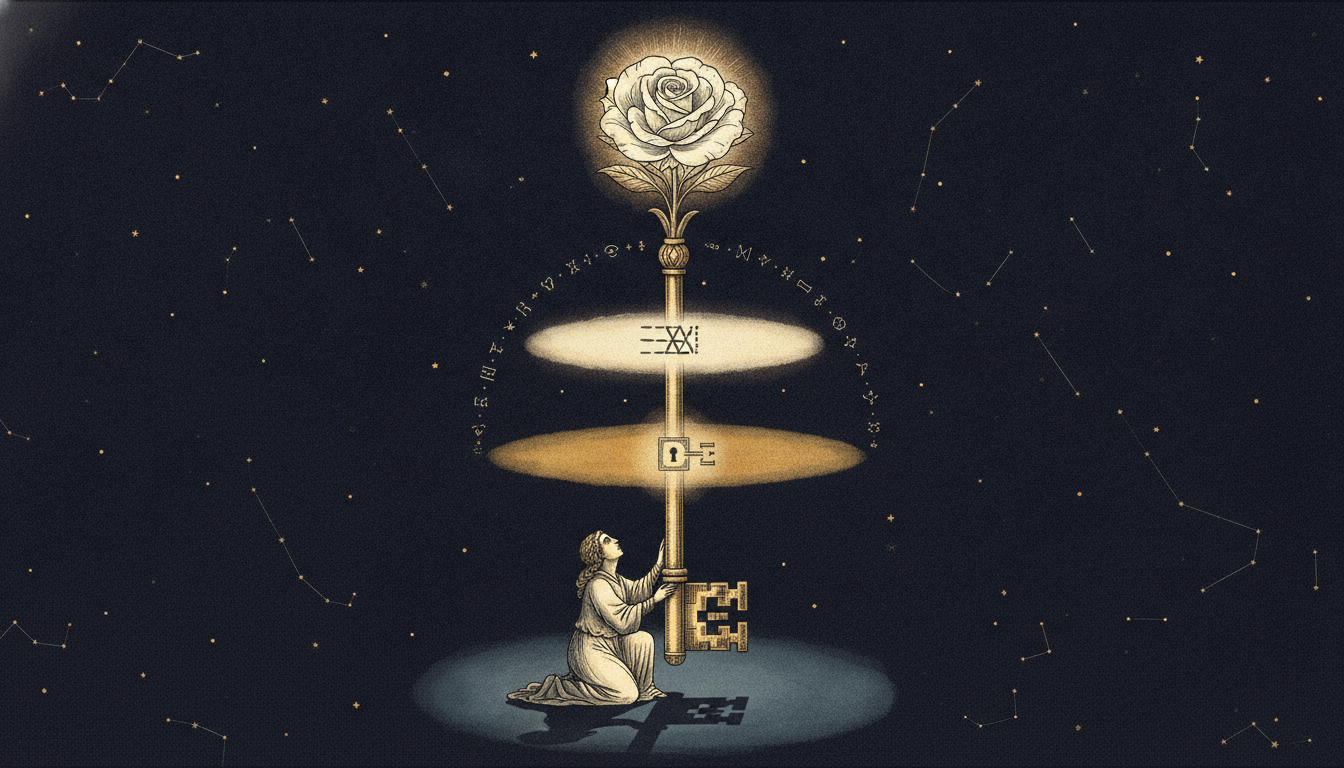
Gene Keys is a system of 64 archetypes, each one carrying a single human theme at three frequencies. Richard Rudd introduced it in his 2009 book Gene Keys, and he built it from the same birth chart Human Design uses, which is why the two share their 64 numbers.
The whole thing rests on one idea. Every pattern in you, including the ones you'd rather not have, is an energy with a low end and a high end. The low end is the Shadow. The high end is the Siddhi. The Gift lives between them, and the way up is through the bottom.
What are the Gene Keys?
The Gene Keys are 64 archetypes, and each one has a name at every frequency. Rudd lined them up with the 64 hexagrams of the I Ching and, in his framing, with the 64 codons of DNA, which is where the word "gene" comes from. If you've looked at a Human Design chart, the 64 gates are the same 64 keys.
Here's what a few of them look like across the spectrum:
| Gene Key | Shadow | Gift | Siddhi |
|---|---|---|---|
| 1 | Entropy | Freshness | Beauty |
| 13 | Discord | Discernment | Empathy |
| 25 | Constriction | Acceptance | Universal Love |
| 64 | Confusion | Imagination | Illumination |
Read a row left to right and you can feel it's one thing, seen at three intensities. Confusion, when it stops being feared, turns into imagination. Imagination carried all the way becomes illumination. Same raw energy the whole way up.
Rudd calls the book a transmission rather than a manual, and he means for it to be read slowly, one key at a time, over years. That pace is the design.
What do Shadow, Gift, and Siddhi mean?
They are three frequencies of a single energy, and the frequency depends on how much fear is running through it.
The Shadow is the theme at its lowest frequency, where fear is in charge. Rudd gives every Shadow two faces. The repressive face turns the fear inward: you go quiet, collapse, or numb out. The reactive face turns it outward: you blame, push, or lash out. Take Gene Key 64. The repressed version of Confusion looks like someone who has given up on ever understanding. The reactive version looks like someone who argues to cover the fact that they don't.
The Gift is the same energy once the fear relaxes its grip. Confusion, no longer feared, becomes Imagination. This is the frequency where creativity, real work, and genuine service to other people show up, and it's where most of the practical payoff of the system lives.
The Siddhi is the theme fully realized. The word is Sanskrit and refers to a spiritual attainment. In Gene Keys it marks the highest possibility of each key, and Rudd is clear that it's rare. You don't chase it. It stands as the horizon that gives the Gift its direction.
The move from Shadow to Gift is the heart of the practice, and the method surprises people. You don't fight the Shadow or try to fix it. You accept it. Rudd's claim is that the Gift emerges on its own once the Shadow is fully seen and allowed, and that resisting the Shadow is what keeps it in place.
What is the Hologenetic Profile?
The Hologenetic Profile is your personal Gene Keys chart. It takes 11 planetary positions from your birth data and assigns each one a sphere, a Gene Key, and a line from 1 to 6. The spheres are grouped into three sequences, each one a course of contemplation.
| Sequence | Sphere | Calculated from |
|---|---|---|
| Activation | Life's Work | Personality Sun |
| Activation | Evolution | Personality Earth |
| Activation | Radiance | Design Sun |
| Activation | Purpose | Design Earth |
| Venus | Attraction | Design Moon |
| Venus | IQ | Personality Venus |
| Venus | EQ | Design Venus |
| Venus | SQ | Personality Mars |
| Venus | Core | Design Mars |
| Pearl | Culture | Personality Jupiter |
| Pearl | Pearl | Design Jupiter |
The Activation Sequence is where everyone starts. Its four spheres are the four prime gifts, and Life's Work, your Personality Sun, is the lead theme of your whole profile. The Venus Sequence moves into relationships and the emotional patterns you took on early in life, ending at the Core, which Rudd treats as the deepest wound. The Pearl Sequence turns toward prosperity and how your gifts meet the world, and it revisits two spheres under new names: the Core becomes your Vocation and your Life's Work becomes your Brand.
Each sphere's line, 1 through 6, colors how that key plays out, in the same way the lines of a Human Design profile do.
The Personality side of this chart is calculated for the moment you were born and the Design side for roughly 88 days before it, and both move with the clock. An off birth time can shift a sphere to a neighboring key, so if yours is uncertain, the free birth time finder can narrow it down before you start contemplating the wrong theme.
How do you actually work with the Gene Keys?
You contemplate them. Rudd uses that word deliberately, and he separates it from concentration, which is effortful, and from meditation, which is about emptying. Contemplation is holding a question lightly over time and letting life answer it.
In practice it looks like this. You take one key, almost always your Life's Work first. You read Rudd's chapter on it. Then you carry the key around for days or weeks, and you watch for its Shadow in your ordinary life: at work, in an argument, in the thing you keep avoiding. When it shows up, you notice it. You don't correct it or judge it. Over time, the noticing softens the fear, and the Gift starts coming through on its own.
Then you move to the next sphere. The whole Activation Sequence can take months. The three sequences together are meant to take years, and the book is written to be reread as you change.
How is Gene Keys different from Human Design?
The chart is the same and the purpose is different. Human Design takes the 64 gates and turns them into mechanics: your type, your strategy, your authority, which centers are defined. It's built for daily decisions and pays off fast. Gene Keys takes the same 64 and asks what each one is trying to teach you, and it's built for slow transformation.
Gene Keys also drops the machinery. There's no type or authority in a Hologenetic Profile, and the chart is 11 spheres rather than a bodygraph of nine centers. What it adds is the frequency spectrum and the three sequences. A lot of people run both: Human Design to learn how they operate, Gene Keys to work on what keeps tripping them. The full comparison is in Human Design vs Gene Keys.
Where to go next
If this is your first pass, start with your Life's Work and nothing else. One key, held for a while, teaches more than the whole profile skimmed in an afternoon. If you want to see where your keys sit in the Human Design version of the chart, gates and channels shows how the same 64 numbers get wired together there.
And if you'd rather hear your Hologenetic Profile talked through, sphere by sphere, with the Shadow and Gift of each key read against your actual life, a personalized YouCast episode does that from your exact birth data.