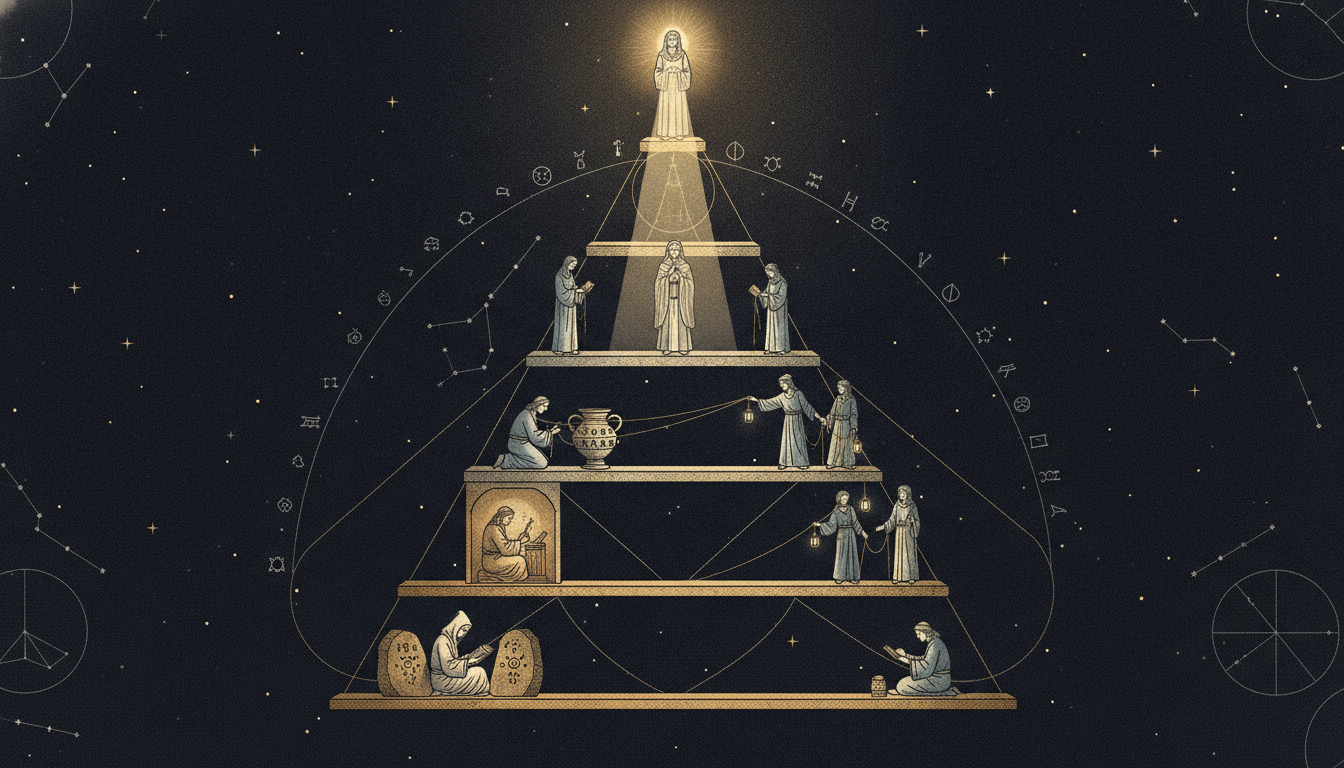
A Human Design profile is the pair of numbers in your chart, written like 2/4 or 5/1. Each number names one of six lines, and the pair describes the role you play in life: how you learn, how you relate, and how other people tend to see you. There are six lines and twelve possible profiles, and once you know what each line does, any profile reads almost by itself.
If you've already looked up your profile and felt a jolt of recognition, that's common. Profile is the most immediately relatable part of the chart. It also carries less weight than people assume, and we'll get to why.
What are the six lines in Human Design?
The six lines come from the I Ching, where every hexagram is built from six stacked lines. Human Design gives each line a character:
| Line | Name | What it does |
|---|---|---|
| 1 | Investigator | Needs a solid foundation of knowledge before it feels secure |
| 2 | Hermit | Has natural gifts it doesn't fully see, and needs time alone until called out |
| 3 | Martyr | Learns by trial and error, discovering what works by bumping into what doesn't |
| 4 | Opportunist | Lives through its network, and opportunities arrive through people it already knows |
| 5 | Heretic | Gets projected on by strangers as the one who can fix things |
| 6 | Role Model | Lives in three stages and eventually becomes an example others learn from |
The first three lines are the lower trigram, and they're personal. They're about building your own foundation, your own gifts, and your own experience. Lines four through six are the upper trigram, and they're interpersonal. They're about network, projection, and becoming an example for others.
How do you read the two numbers in your profile?
The first number is your conscious line, taken from your Personality Sun, the position of the Sun at the moment you were born. This is the part you can feel and name about yourself.
The second number is your unconscious line, taken from your Design Sun, the position of the Sun roughly 88 days before birth. It runs underneath, and it's usually obvious to the people around you long before it's obvious to you.
So a 3/5 consciously experiments and unconsciously draws projection from strangers. A 5/1 is the reverse emphasis: projection is the part they feel, and the deep need for a solid foundation is the part running in the background.
What are the 12 Human Design profiles?
Here are all twelve, with their names:
| Profile | Name | Angle |
|---|---|---|
| 1/3 | Investigator-Martyr | Right Angle |
| 1/4 | Investigator-Opportunist | Right Angle |
| 2/4 | Hermit-Opportunist | Right Angle |
| 2/5 | Hermit-Heretic | Right Angle |
| 3/5 | Martyr-Heretic | Right Angle |
| 3/6 | Martyr-Role Model | Right Angle |
| 4/6 | Opportunist-Role Model | Right Angle |
| 4/1 | Opportunist-Investigator | Juxtaposition |
| 5/1 | Heretic-Investigator | Left Angle |
| 5/2 | Heretic-Hermit | Left Angle |
| 6/2 | Role Model-Hermit | Left Angle |
| 6/3 | Role Model-Martyr | Left Angle |
Each profile has its own full page on this blog. Click through to yours.
Why are there only 12 profiles?
Because the two Suns sit a fixed distance apart. The Design Sun is always about 88 degrees of solar arc before the Personality Sun, and that spacing locks the two lines into a small set of pairings. Six lines could combine 36 ways on paper, and the geometry only allows twelve. You'll never meet a 1/6 or a 4/2.
The lower and upper trigrams also mirror each other in harmonic pairs: 1 with 4, 2 with 5, 3 with 6. Six of the twelve profiles are built from a harmonic pair (1/4, 2/5, 3/6, 4/1, 5/2, 6/3), which is why those lines read as two sides of one theme.
What do Right Angle, Left Angle, and Juxtaposition mean?
The angle tells you whose story your life is mostly about.
Right Angle profiles (1/3 through 4/6, seven of the twelve) live a personal life. The path is largely self-directed, and the people who show up are part of your story more than you are part of theirs.
Left Angle profiles (5/1, 5/2, 6/2, 6/3) live a transpersonal life. The people who cross your path shape where it goes, and you play a significant part in other people's stories.
Juxtaposition is the 4/1 alone. Its path runs on a fixed track, neither personal nor transpersonal, and a 4/1 tends to stay itself no matter what's happening around it.
Does your profile matter more than your type?
No, and this is the part people get backwards. Type and authority are the engine. They describe how you're built to engage with life and how decisions are actually meant to be made for you. Profile is the costume you wear while that engine runs.
A 2/4 Generator and a 2/4 Projector share a costume and live very different lives, because one waits to respond and the other waits for the invitation. So read your type first, then your authority, then your profile. In that order the profile makes sense. Out of order it can turn into a personality quiz.
Can your profile be wrong?
Yes, if your birth time is off. The Sun moves through one line roughly every day, so a birth time that's off by a few hours can land you on the neighboring line, and a 3/5 becomes a 4/6. Those are genuinely different lives. If your birth time came from a fuzzy memory or a rounded hospital note, the free birth time finder helps you narrow it down before you build anything on the reading.
Where to go next
Find your profile in the table above and read its full page. Then see how to read your chart for how the profile fits alongside your type, authority, and channels.
If you want your profile talked through as it actually lives in your design, with your type, your authority, and your own channels threaded in, that's what a personalized YouCast episode is. Your whole chart, read out loud, built from your exact birth moment.