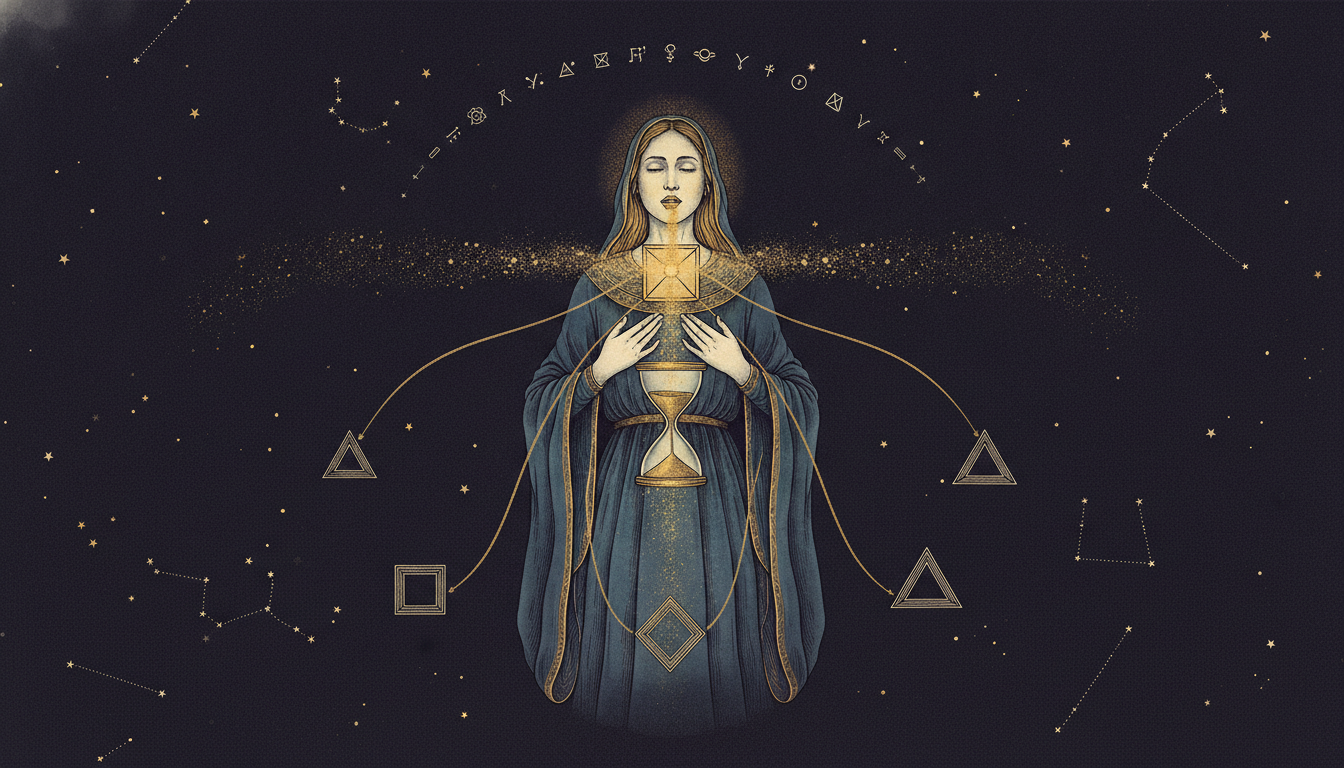
Gate 20 is the Gate of the Now. It lives in the Throat center, the square near the top of your Human Design chart where energy turns into words and action, and it only has one tense. Whatever it says, it says about this moment.
That makes it one of the most recognizable gates in the chart once you know what you're hearing. Each Throat gate is often given a voice, a short phrase for how it speaks, and Gate 20's is "I am now."
What does Gate 20 mean?
Gate 20 means you have a line from the present moment straight to your voice. The I Ching hexagram behind it is called Contemplation, and in Human Design that becomes an awareness of what's happening right now, expressed as it happens.
Here's the quick reference:
| Feature | Gate 20 |
|---|---|
| Name | The Gate of the Now |
| Center | Throat |
| I Ching hexagram | 20, Contemplation |
| Channel partners | Gate 34 (Sacral), Gate 57 (Spleen), Gate 10 (G center) |
| Circuit | Integration |
| Theme | Presence, saying and doing what this moment calls for |
| Common trap | Talking to fill the moment instead of noticing it |
| Gene Key 20 | Shadow of Superficiality, Gift of Self-Assurance, Siddhi of Presence |
The Throat has eleven gates, and several of them speak from somewhere else in time: what I remember, what I've experienced, what I'm going to try. Gate 20 has no past or future in it. Rehearsing is close to useless for this gate, because by the time the prepared line arrives, the moment it was written for has moved on.
What does it feel like to have Gate 20 defined?
A defined Gate 20 feels like knowing what to say only at the second you need to say it. You might walk into a room with nothing prepared, then open your mouth and hit exactly what the situation needed. The same person can freeze completely when asked to write a speech a week ahead.
Other people often feel it before they can name it. When someone says a plain, accurate thing about what's going on in the room, everybody suddenly notices where they are. That's Gate 20 at its best.
The trap comes when the voice runs without the awareness. Gate 20 can turn into narrating everything, commenting on everything, or jumping in because a silence felt uncomfortable. The words come out in the present tense either way. The difference is whether you were actually paying attention to the moment when you said them.
What are the three channels of Gate 20?
Gate 20 can complete three different channels, and each partner gives its voice a different source.
20-34, the Channel of Charisma (Throat to Sacral). Gate 34 is the Gate of Power, raw Sacral life force built for independent action. Joined to Gate 20, that power gets a direct line to the Throat, and thought and action fuse into doing. People with this channel move fast, handle several things at once, and tend to be visibly busy being themselves. It's the channel most people picture when they think of a Manifesting Generator, and Gate 34 has its own page if you'd like the Sacral side of the story.
20-57, the Channel of the Brain Wave (Throat to Spleen). Gate 57 is the Spleen's intuitive gate, the clearest in-the-moment knowing in the chart. Joined to Gate 20, intuition gets a live microphone. People with this channel can say what they sense as they sense it, and it may surprise them as much as anyone. Since the Spleen speaks once and softly, the words often come out before the mind has a chance to edit them.
10-20, the Channel of Awakening (Throat to G center). Gate 10 in the G center is about behavior and how you carry yourself. Joined to Gate 20, being yourself becomes something you express in real time. The channel's theme is commitment to higher principles, and people with it tend to teach by demonstration: other people learn what they stand for by watching how they act.
All three belong to the Integration circuit, the four gates (10, 20, 34, and 57) that all connect to one another, with self-empowerment as the theme across the board. Gate 20 is the circuit's only way to the Throat, so everything Integration has to say or do goes through this gate.
What does it mean to have Gate 20 but no channel?
Having Gate 20 with none of gates 34, 57, or 10 is called a hanging gate. Your Throat may still be defined through a different channel, or it may be open, but Gate 20 itself is waiting for a partner.
That partner shows up in other people. Around someone carrying Gate 34, 57, or 10, the channel completes between you, and you may find yourself more articulate or quicker to act than you are alone. Plenty of people with a hanging Gate 20 know this feeling without knowing why: the words come easily with certain people and go missing with others.
If your Throat is open, you may also feel pressure to speak up so that you get noticed. The moment doesn't need you to perform for it. When you're asked, or when something real comes through, the voice tends to work fine.
Gate 20 and the Manifesting Generator
A single gate never sets your type. Type comes from which centers are defined and how they connect, so Gate 20 alone doesn't make anyone anything.
The 20-34 channel is the exception people ask about, because it connects a motor straight to the Throat. With that channel, your Sacral is defined and wired to your voice, and that makes you a Manifesting Generator. The 20-57 and 10-20 channels define the Throat too, but the Spleen and the G center aren't motors, so neither one creates that connection by itself.
That's why birth time matters here. Gate 20 can be activated by a fast-moving planet, and the Moon crosses a gate in roughly ten hours. A birth time that's off by a few hours can add or remove one half of this channel and move you between Generator and Manifesting Generator. If you're not sure of yours, the free birth time finder can help you narrow it down.
When does the Sun pass through Gate 20?
The Sun moves through all 64 gates once a year, spending just under six days in each, and it crosses Gate 20 in late May. Anyone born in that window has Gate 20 in their Personality Sun, the most influential position in the chart, and the present-tense voice tends to be a big part of how people experience them.
Everyone feels a little of it during that week each year. It's a good time to catch yourself mid-sentence and check whether you're talking about what's actually in front of you.
What is Gene Key 20?
The Gene Keys read the same 64 positions as a spectrum of frequency rather than a mechanic. Gene Key 20 runs from the Shadow of Superficiality, through the Gift of Self-Assurance, to the Siddhi of Presence.
Superficiality is attention that skims. You're in the room and half somewhere else, reaching for the next thing to say or the next thing to look at. Self-Assurance is what shows up when that reaching stops, an ease in being exactly where you are, with no need to posture. Presence is the far end of the same line, where hardly any words are needed at all.
You can read the whole arc as the Gate 20 lesson in different language: the less you reach for the moment, the more of it you actually get.
Where to go next
For the mechanics behind this, gates and channels explained covers how gates pair into channels and define centers. For a broader look at what's happening around Gate 20, the nine centers guide explains what the Throat does for the whole chart.
And if you'd like to hear how your own Gate 20 runs, which channel it completes or who completes it for you, alongside everything else in your chart, a personalized YouCast episode talks it through from your exact birth data.